
Dib has spent years building a structured, AI-ready picture of a home. The appliances and the long tail of stuff in every room. The vehicles in the driveway. The manuals, receipts, warranties, and inspection reports in the documents vault. The maintenance history, the tasks, and the profile of the property itself, right down to the HVAC, water heater, roof, and electrical.
That picture has always lived inside the Dib app. Today it's open to builders.
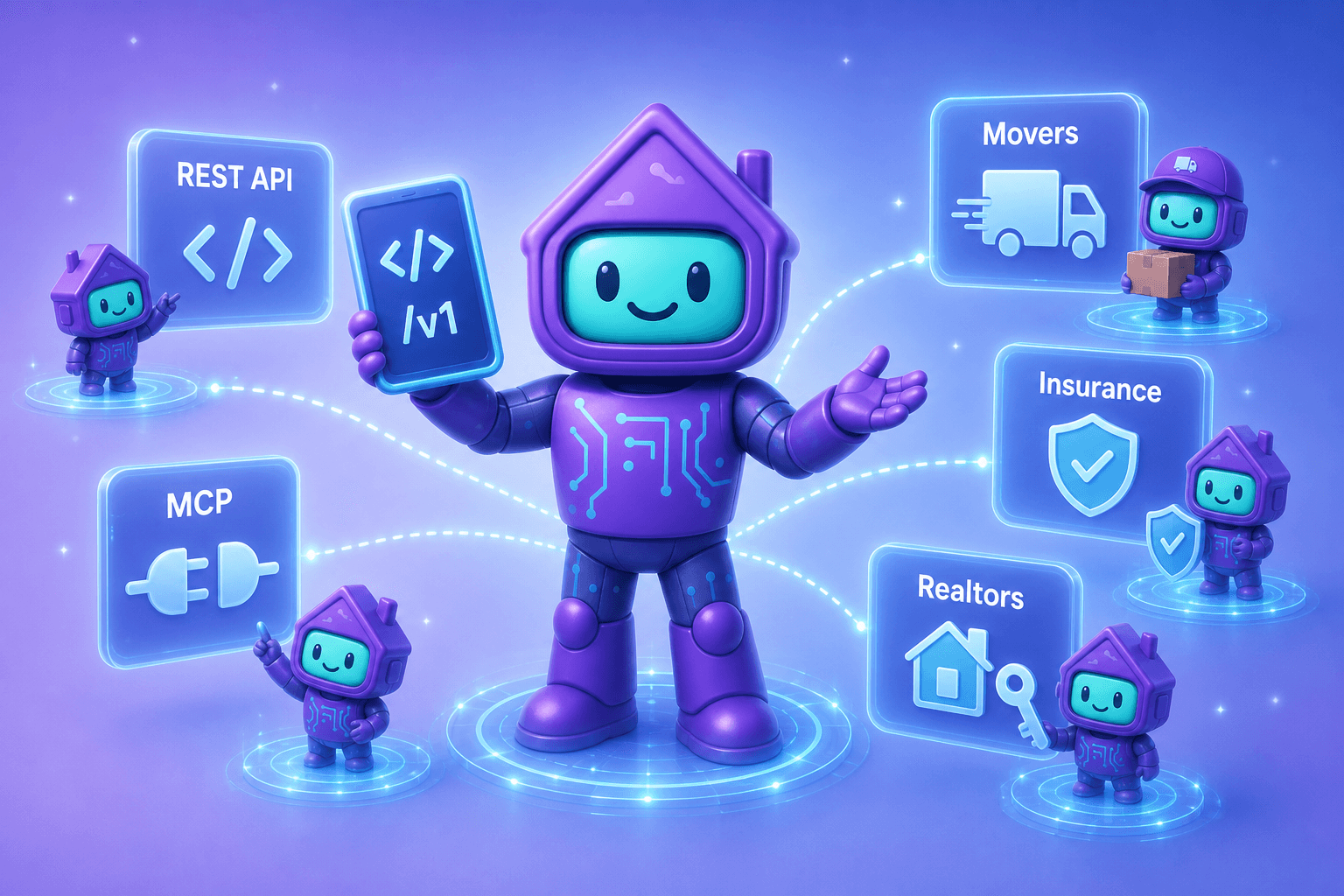
The Dib Public API is in public preview. It's a REST and MCP surface for everything Dib knows about a home, plus a Partner Provisioning API for standing up brand-new homes and a hosted "Connect with Dib" flow so your users can grant access in a single click. Everything lives at dib.io/developers, including an interactive reference, a live playground, and the OpenAPI spec.
Why we built a public API
Home data is scattered by nature. It arrives as a photo of a serial plate, a PDF warranty, a scribbled service date, a receipt buried in an inbox. Dib's whole job is to turn that mess into something structured and searchable. Once it's structured, the obvious next question is: what else could this power?
- A moving company that pre-loads your new home with the appliances from your old one.
- A home warranty provider that reads your real inventory instead of asking you to type it out.
- A property manager syncing every unit's documents and tasks into their own system.
- An AI assistant in Claude or Cursor that can actually answer "when was the furnace last serviced?" because it can see your maintenance log.
All of these need the same thing: a clean, permissioned way to read and write home data. That's the API.
What's in the box
A REST API for the whole home
The /v1 surface covers the full model:
- Inventory including a Smart Add endpoint that turns a photo into structured items using the same pipeline behind the Dib mobile app.
- Vehicles with metadata.
- Documents with OCR text and structured field extraction (warranty dates, totals, brands), plus a one-off extraction endpoint for documents you don't want to store.
- Tasks and reminders, rooms, and the property profile (address, characteristics, value, utility providers, and major systems).
- Cross-resource search and Dib's AI chat surface.
- A change feed over polling or server-sent events, so partner systems stay in sync with everything that happens on a team.
- Async exports for pulling a full account in bulk.
It's designed to feel familiar. Cursor-based pagination, ISO timestamps, updated_since filters for incremental sync, and a consistent envelope on every response.
curl -H "Authorization: Bearer $DIB_API_KEY" \
     -H "Dib-API-Version: 2026-06-01" \
     https://dib.io/api/v1/inventory?limit=5
An MCP server for AI clients
The Model Context Protocol is how modern AI clients plug into external tools. Dib ships a hosted MCP server at https://dib.io/api/mcp that mirrors the REST surface as a set of scope-gated tools: searching, listing and reading inventory, vehicles, tasks, documents, and rooms, plus write tools like dib_create_inventory, dib_create_vehicle, dib_create_document, and dib_update_task.
Drop your Dib API key into Claude Desktop, Cursor, VS Code, or any MCP client and your assistant can answer real questions about a specific home. For clients that can't paste a key, we run a full OAuth flow, so a user can authorize access and pick which home to connect without ever handling a raw credential.
This is the piece that turns "an AI assistant that knows things in general" into "an AI assistant that knows your house."
A Partner Provisioning API for creating homes
The REST API reads and writes data for a home that already exists. Approved partners often need the opposite: to create a home from scratch on a user's behalf. That's the Partner Provisioning API.
It works in stages. A partner opens a "setup" (a staging container), uploads documents, sets structured values for the property, inventory, vehicles, rooms, and tasks, then finalizes it into a real Dib account. A realtor handing over a house, an insurer onboarding a policyholder, or a builder delivering a new build can populate a complete, useful Dib home before the owner ever logs in.
"Connect with Dib" for existing users
When a partner wants access to a home that already exists, the user stays in control. Connect with Dib is a hosted consent screen, similar to signing in with Google. The user sees exactly which scopes are requested, approves, and a scoped key is minted for the partner. No credentials are copied around, and the user can revoke access at any time.
Security and permissions, by design
Home data is sensitive, so access is narrow by default.
- Team-scoped keys. Keys are issued per team in the
dib_live_*anddib_test_*formats, sent asAuthorization: Bearer ...orX-Api-Key. Partner provisioning uses separatedibp_*keys that are not team-scoped. - Granular scopes. Every capability maps to a
resource:actionscope likeinventory:read,property:write, orai:chat. A key only does what it was granted. - A test mode.
dib_test_*keys hit a sandbox team, so you can build and demo without touching real data. - IP allowlists on keys that need them, plus rate limits and abuse detection on every request.
- Dated versioning, Stripe-style. Pin the
Dib-API-Versionheader (current:2026-06-01) to lock in today's response shape. Breaking changes ship under new dates with a sunset window, announced in the changelog.
Getting started in about five minutes
- Head to dib.io/developers and create a key for your Pro team.
- Call
GET /v1/meto confirm your team, granted scopes, plan, and rate limits. - Explore the interactive reference and hit endpoints live in the playground.
- Follow a guide: keep a local mirror in sync, capture inventory from a photo with Smart Add, or ingest a document end to end.
Building with an AI coding assistant? We publish a ready-made brief at dib.io/developers/llms.txt. Paste it into Cursor, Claude, or ChatGPT and your assistant learns the whole API, auth, pagination, scopes, and all.
A note on "public preview"
The API is officially in public preview. It's open to Pro teams with API access, and it's stable enough to build on, but the surface may still change during the preview period. We announce changes ahead of time in the developer changelog (with an RSS feed), and the formal stability and deprecation guarantees take full effect at general availability. Pin your API version, watch the changelog, and you'll have plenty of runway.
Frequently Asked Questions
Who can get an API key?
Any Pro team with API access enabled. You create and manage keys from the developer portal at dib.io/developers.
What's the difference between the REST API and the MCP server?
Same data, different shape. REST is the classic request/response surface you'd wire into a backend or sync job. MCP exposes those same capabilities as tools an AI client can call directly, so an assistant like Claude or Cursor can read and write home data in a conversation. Both use the same keys and the same scopes.
How do I connect the MCP server to Claude or Cursor?
Point your MCP client at https://dib.io/api/mcp and authenticate with your Dib key, or use the one-click connect and OAuth flow for clients that support it. Full setup steps are at dib.io/developers/mcp.
When would I use the Partner Provisioning API instead of the regular API?
Use provisioning when you need to create a brand-new Dib home for someone (a realtor, insurer, or builder onboarding a new owner). Use the regular /v1 API when you're reading or writing data for a home that already exists.
Is my users' data safe?
Access is scoped and revocable. Keys only carry the scopes they're granted, Connect with Dib keeps users in control of consent, and requests are rate-limited and monitored. Test mode lets you build without touching real homes.
How is the API versioned?
With dated versions in the Dib-API-Version header. Pin a date to lock in a response shape; breaking changes arrive under new dates with advance notice and a sunset window.
Ready to build?
Grab a key, call GET /v1/me, and make your first request. Then decide what you want to build: a sync, an AI integration, or a full onboarding flow that hands users a home that already knows itself.
Start at dib.io/developers.