
You're crouched in front of the dishwasher. The display shows an error code you've never seen before, four characters that mean absolutely nothing to a human. You think about Googling it. But the search results will all be for the wrong model, or for a similar model with different parts, or behind a paywall.
What you actually want is to ask your house. "Hey, what does E24 on the dishwasher mean?" And have something useful come back, because the answer is sitting in the manual that came with the dishwasher and you just don't want to flip through 80 pages to find it.
This is exactly what Dib's AI chat is built for. It's not a generic chatbot. It's an AI assistant for your home that knows what you've saved (inventory, documents, manuals, maintenance history) and answers questions grounded in that information.
What "ask your house" actually means
Dib's AI chat is an AI assistant scoped to your home. It can:
- Read your manuals and answer technical questions about your specific appliances and equipment
- Look up your maintenance history and tell you when something was last serviced
- Find documents by what's in them, not just by filename
- Summarize project history ("when did we redo the kitchen, and who did the work?")
- Surface upcoming reminders ("anything I should be doing this week?")
- Recommend next steps based on what it knows about your home
Importantly, it's grounded in your information. It's not making up the dishwasher's error code from training data. It's reading the manual you uploaded.
Why this is more useful than a normal chatbot
Generic AI assistants are impressive, but they don't know your house. They don't know which water heater you have. They don't know what was on last year's inspection report. They don't know which paint went on the dining room walls. So they're forced to give general answers ("contact a licensed plumber") instead of useful ones.
Dib's chat knows the specifics. That's the whole pitch:
- Specific answers, not general advice. "Your Bosch SHPM78Z55N's E24 code means drain blockage" is far more useful than "have you tried Googling that error?"
- Pulls in your maintenance log. "The HVAC was last serviced October 12 by Smith HVAC, and the next service is due in April."
- Searches across everything. "Where's the warranty on the washer?" pulls up the right document immediately.
- No prompt engineering needed. You ask in plain English. The AI handles the rest.
- Cited answers. When the AI gives you info from a specific document, it shows you the document. You can verify in one tap.
We dug into the broader AI story in how Dib's AI makes home management effortless and from binders to AI. This post focuses on the chat experience itself.
How Dib's AI chat works
It reads your stuff first
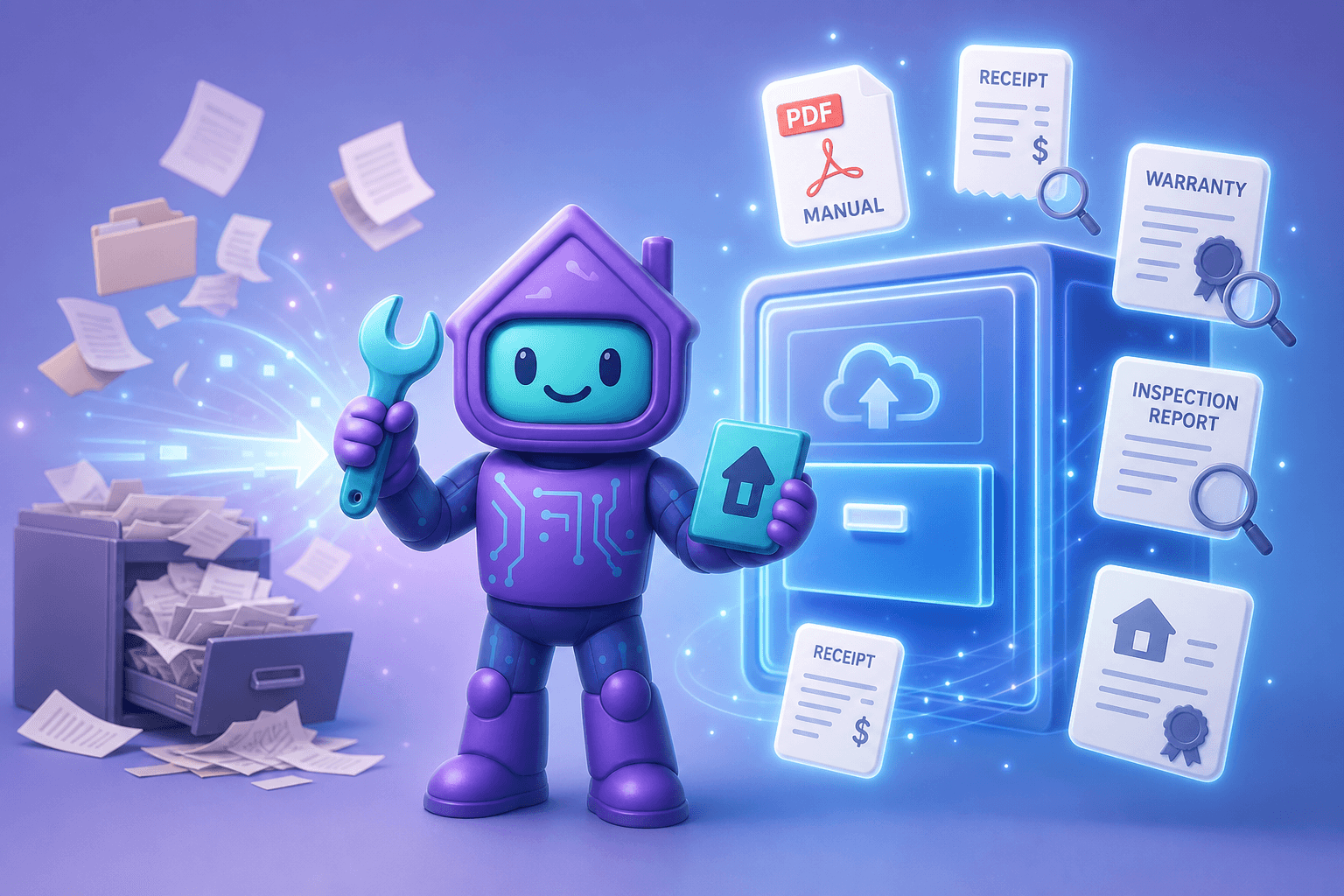
When you upload a manual to your documents vault or add an appliance via Smart Add, the contents become available to the AI chat. Same goes for receipts, project records, finishes, contracts, and maintenance logs.
Plain English in, useful answer out
You type (or speak) a question the way you'd ask a friend. "What's that beeping in the basement?" "When did we paint the bedroom?" "How much did we spend on the kitchen?" The AI figures out where to look and gives you the answer.
Citations on demand
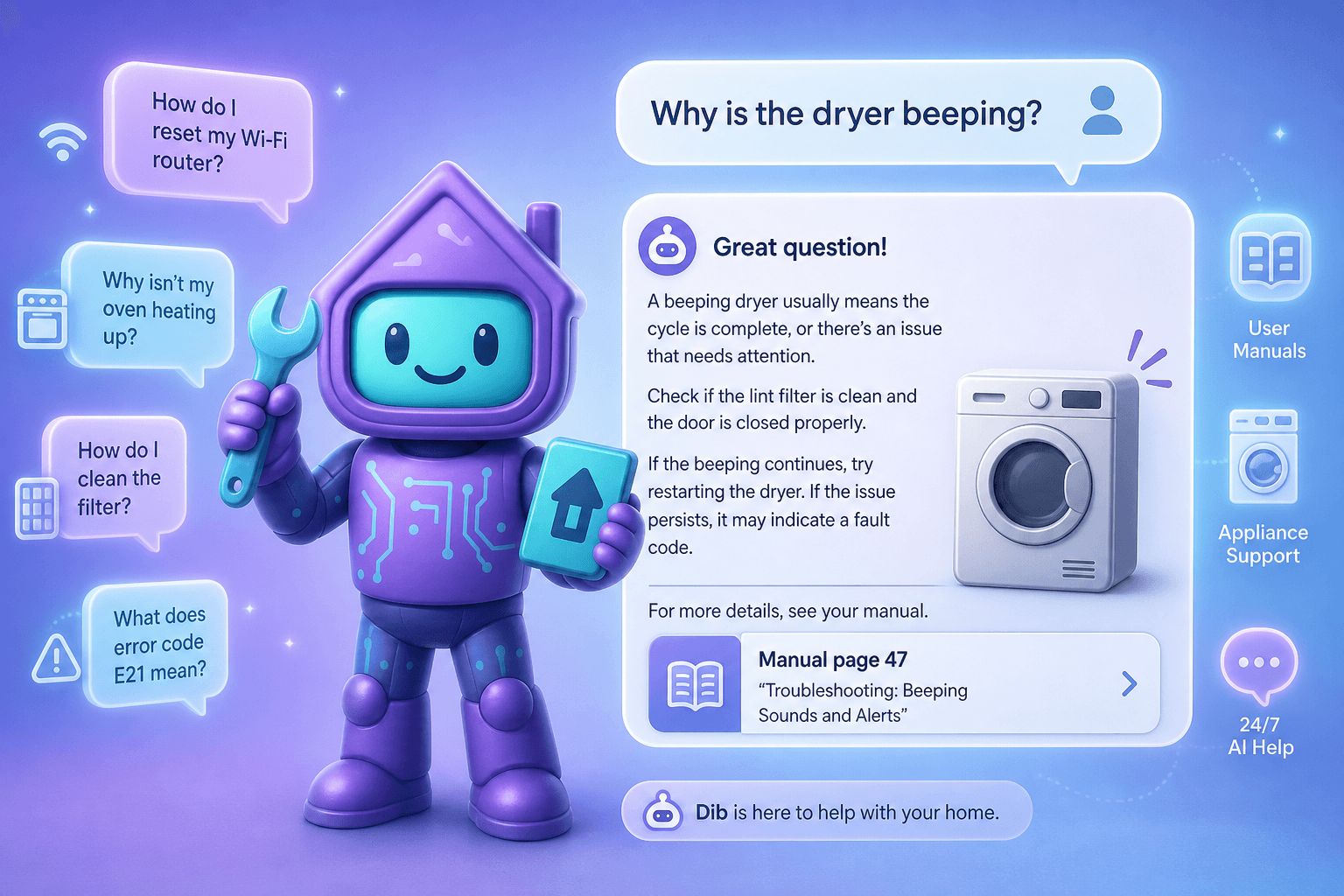
Most answers include a link to the underlying document or record. You're never just trusting the AI. You can tap through to the manual page, the receipt, the maintenance log entry, or the project record that the answer came from.
Conversation history
Chats are saved to a chat archive so you can revisit useful answers later. The HVAC technician's explanation, the dishwasher fix you finally figured out, the paint color you finally remembered.
Knows when to say "I don't know"
If the answer isn't in your data, the AI tells you. It might suggest what would help (uploading the manual, adding the maintenance log, photographing the receipt) but it won't fabricate. This is one of the most important parts of a useful AI assistant.
Powered by current models
Dib uses leading large language models from Anthropic and OpenAI for chat responses. The model is the engine. Your home data is the steering wheel.
Picture this
Sunday afternoon. The dryer is doing something weird, like it's tumbling but not heating.
You open Dib chat. You type: "Why isn't the dryer heating?"
The chat replies with something like this:
Your dryer is the LG DLEX7800VE in the laundry room. From your manual, the most common causes of "tumbles but no heat" are: a tripped thermal fuse, a failed heating element, or a clogged dryer vent restricting airflow. Your last vent cleaning was 14 months ago (logged March 2024), which is on the longer side, so vent restriction is plausible.
Manual reference: page 47, troubleshooting section.
Want me to remind you to clean the vent this weekend, or pull up the LG support contact?
This is the kind of answer that actually unblocks you. No Googling. No flipping through the manual. No guessing.
Tips to get the most out of it
- Feed the AI before you need it. The more manuals, receipts, and maintenance entries are in Dib, the more useful chat becomes. The documents vault and Smart Add are the main inputs.
- Ask specific questions when you have them. "What's the warranty on the water heater?" is much easier for the AI to answer than "tell me everything about my water heater."
- Verify with citations. If something matters, tap through to the source document. The AI is good, not infallible.
- Use the chat archive. When the AI helps you solve a problem, the conversation is saved. Future-you might face the same issue.
- Don't ask it for medical, legal, or licensed advice. It's a home assistant, not a doctor or lawyer. For anything safety-critical, escalate to a real pro.
Frequently Asked Questions
What models is Dib's AI chat built on?
Dib's chat is powered by leading large language models from Anthropic (Claude) and OpenAI (GPT-class). The choice of model depends on the task, with Claude doing most of the heavy lifting for reasoning over your home documents.
Is my home data used to train AI models?
No. Your data is used to answer your questions, in your account. It's not used to train public models, and it's not shared with other accounts.
How accurate is it?
When the answer is in your data (your manual, your maintenance log, your receipt), the AI is generally very accurate. When the answer isn't in your data, the AI is meant to say so rather than guess. Always verify safety-critical answers against the underlying document.
What if Dib's AI gets something wrong?
Tap the citation, check the source, and correct it. You can also flag a response to help improve future answers. The chat is a tool to save you time, not a replacement for your own judgment.
Can I ask it to do things, not just answer questions?
Some basic actions, yes. Setting a reminder, creating a task, summarizing a project, drafting a message to a contractor. The chat is steadily growing into a more active assistant.
What about voice instead of typing?
Yes. The Dib app supports voice input, so you can ask while you're elbows-deep in a repair without typing. The answers come back in text (with optional audio readback) so they're easy to scan.
Ready to ask your house something?
Upload one manual to Dib. Then ask the chat a real question about that appliance. The first useful answer is usually the moment people understand what this feature is actually for.