
Picture the classic homeowner moment. The garbage disposal jams. You have to reset the breaker. You open the electrical panel, stare at 30 little switches labeled in faded pencil from 1998, and start the ritual: flip a breaker, listen for what just turned off, hope it was the right one, flip it back, repeat.
Half an hour later you've successfully reset the bedroom clocks, dropped the garage door opener, and somehow turned off the freezer. The disposal is fine, but you're not.
This wastes time, and it's slightly dangerous. Working in a panel you don't understand is the kind of "small thing" that creates real risk: electric shock, fried appliances, undocumented wiring for the next pro who shows up. The fix is laughably simple: map your panel once, write it down, never do the dance again.
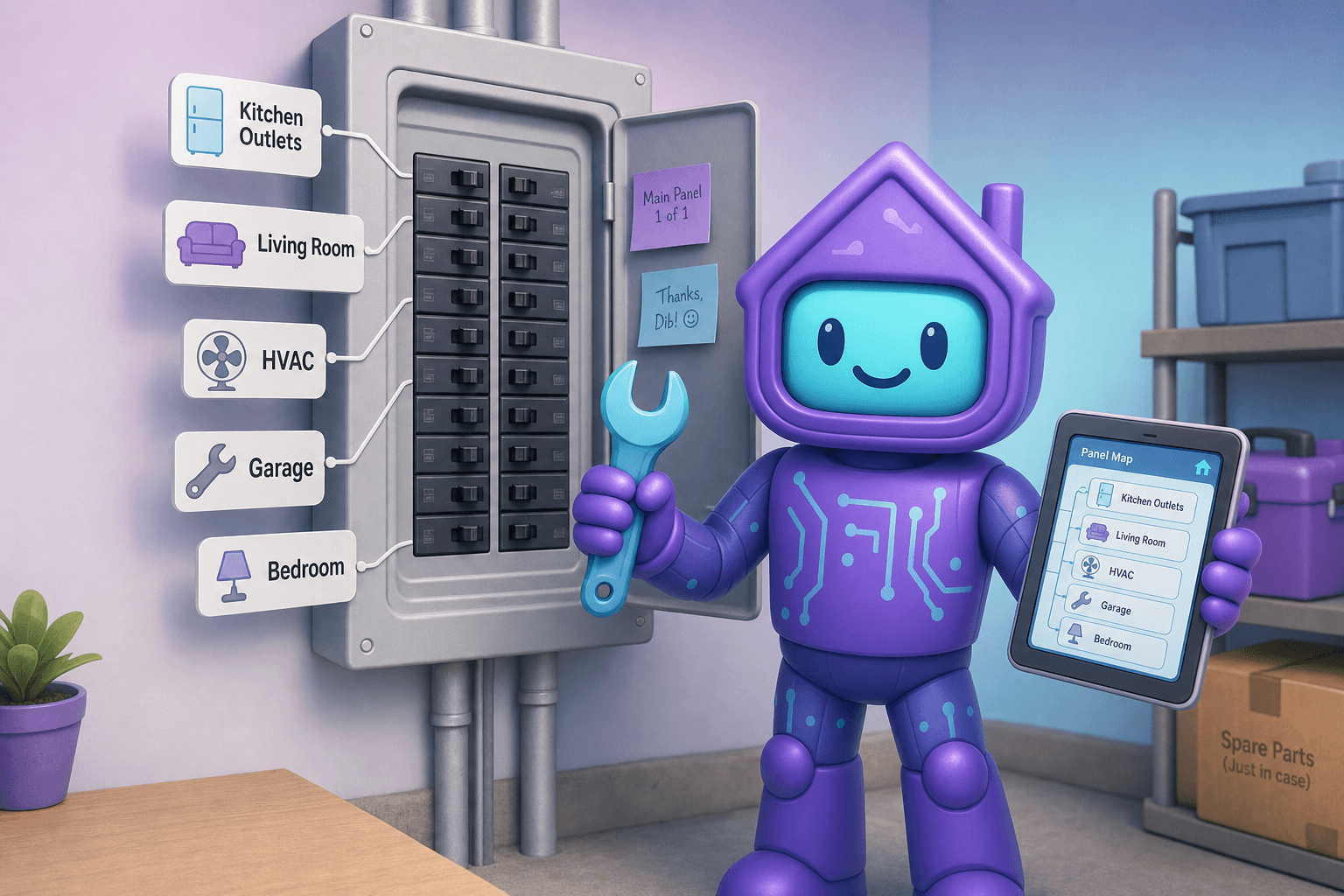
Dib's electrical systems feature is built for this. It's a breaker panel mapping tool that gives every circuit a name, a labeled photo, and a record that anyone in your house can pull up.
What is electrical panel mapping?
It's the process of identifying which circuit breaker controls which outlets, switches, lights, and appliances, then writing it down somewhere durable. A good map answers three questions:
- "If I need to cut power to X, which breaker is that?"
- "If breaker Y trips, what's going to be off?"
- "If a pro asks what's on circuit Z, what's the answer?"
Most homes either have no map at all, or have a faded handwritten label inside the panel that's been wrong since the kitchen was remodeled in 2007. Updating it is one of the highest-leverage 90-minute projects you can do.
Why this is worth your Saturday morning
- Safety. Working on an outlet, a fixture, or an appliance starts with cutting power. A correct map means you cut the right power the first time. A wrong or missing map means you guess, which is exactly when accidents happen.
- Speed. Resetting a tripped breaker takes 10 seconds with a map, 20 minutes without.
- Resilience. Power surges, lightning, and quick storms cause trips. A labeled panel makes recovery routine.
- DIY projects. Hanging a light fixture, swapping an outlet, adding a smart switch, replacing a ceiling fan. All start with "kill the right breaker."
- Pros work faster. Any electrician walks in and asks if you know the panel layout. "Yes" cuts an hour off the job. "No" means they have to map it before they can do the work you're paying them for.
- Inspection and selling. A clearly labeled panel reads as a well-cared-for home. Inspectors notice.
How Dib's electrical panel mapping works
A photo of your actual panel, labeled
Snap a photo of your open panel. In Dib, tap each breaker on the photo and give it a name. "Kitchen counter outlets." "Living room ceiling fan and lights." "HVAC condenser." "Garage outlets, north wall." You end up with a clickable, labeled image of your actual panel, not a generic spreadsheet.
Tied to rooms and circuits
Each breaker can be linked to the rooms or fixtures it serves. Now when you look at the kitchen, you can also see which breakers feed it. When you look at the panel, you can see what rooms each breaker feeds. Two-way navigation.
Notes for the weird stuff
Old houses are full of "this outlet is on the same circuit as the garage somehow." Capture that. "Breaker 17 is the dishwasher AND the disposal." "Breaker 23 is the office, except for the one outlet by the window which is on 24 for some reason." That kind of note is gold the first time you need it.
Sub-panels and outbuildings
Many homes have more than one panel. Main panel, sub-panel in the basement, sub-panel in the garage, separate panel in a shed or ADU. Dib handles all of them as separate panels with their own maps.
Pairs with the emergency plan
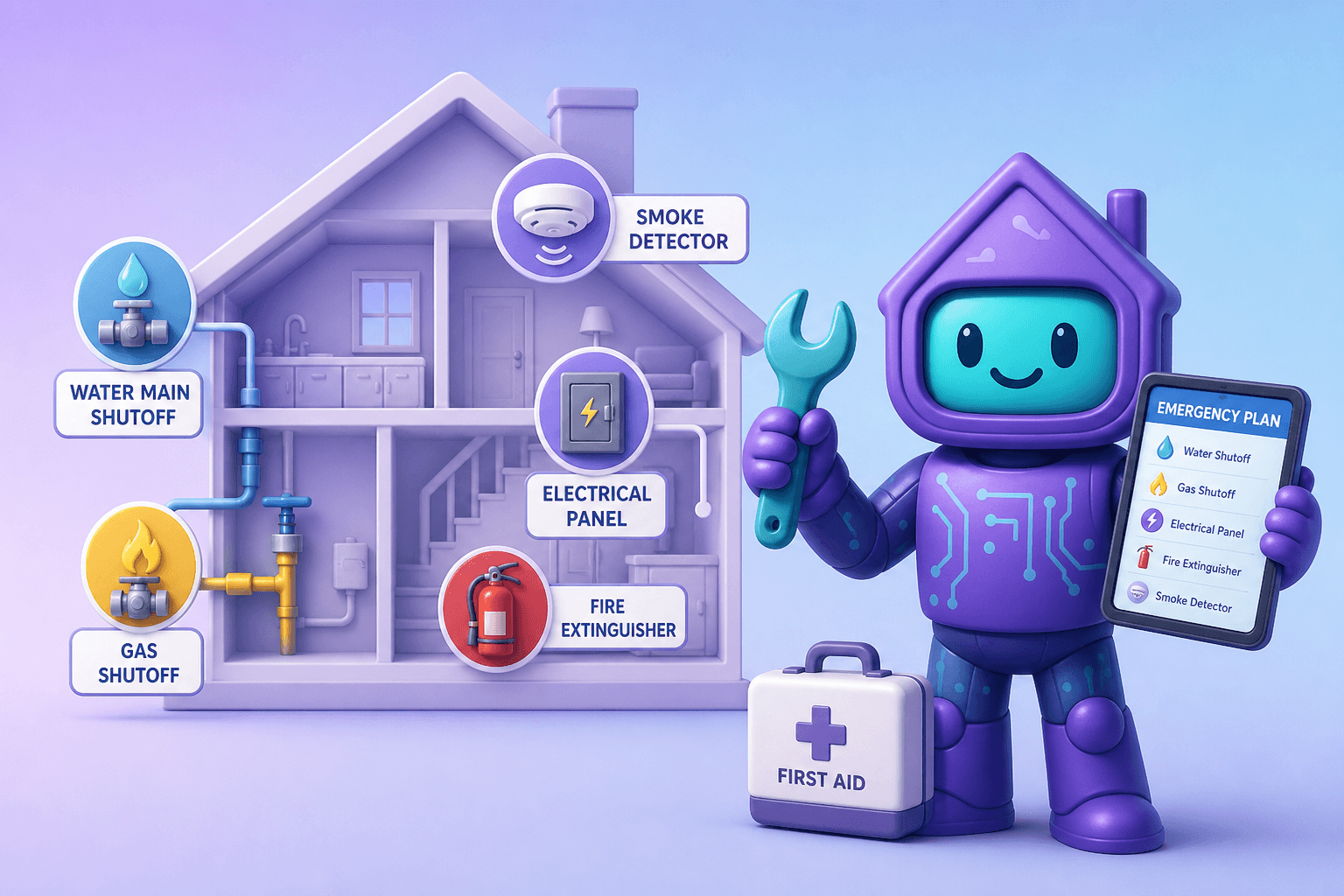
Your panel is one of the most important things on your home emergency plan. The labeled photo lives there too, so a sitter or partner who needs to find the right breaker doesn't have to guess.
How to actually map your panel
This is one of those projects that's much easier with two people, but doable solo with a clamp-on light timer or even just a working flashlight. The rough flow:
- Open the panel. Take a clear photo for Dib.
- Turn everything in the house on. Lights, TV plugged in, music playing in different rooms.
- Flip one breaker. Walk through the house and note what's off. Add to Dib.
- Flip it back on, move to the next.
- Repeat. 30 breakers takes about 90 minutes, plus or minus.
- Test reset. Pick three breakers at random. Find them in Dib. Confirm Dib's label matches what's actually on that circuit.
You'll learn things. You'll discover that the bathroom GFCI you've been ignoring is actually on the same circuit as the laundry. You'll learn that one outlet in the dining room is mysteriously on a kitchen breaker because of a remodel from 2003. All of that goes in the notes.
Picture this
The kids' room outlet pops. The TV in their room and one nightstand lamp both go out. You don't know which breaker.
Open Dib. Tap the kids' room. There's the circuit list: "Breaker 19, kids' bedroom outlets, west wall." You walk to the panel, flip 19, flip it back. Power's restored. You diagnose the actual problem (overloaded power strip) in about three minutes.
Total time spent in the panel: 30 seconds. Total time spent guessing: zero.
Six months later your kid's friend's parent is babysitting and the same thing happens. They text you for help. You send them the labeled panel photo. They handle it in two minutes without bothering you again. That's the dream.
Tips for a great panel map
- Take the photo straight-on with good lighting. A clear photo is the foundation of the whole feature.
- Be specific. "Kitchen" is okay. "Kitchen counter outlets, north wall" is much better. Future-you (or your electrician) will appreciate the precision.
- Don't trust the original labels. A label that's been there since 1998 is probably half-wrong. Verify everything.
- Note what trips often. "Trips with microwave + toaster simultaneously" is useful info that pure mapping doesn't capture.
- Update the map after any electrical work. New circuits added, an outlet moved to a different breaker, a panel replacement. Update the day it happens.
- Loop in your partner. Both of you should know the panel. The benefit only works if more than one person can use it.
Frequently Asked Questions
Is mapping the panel myself safe?
Yes. You're not opening anything energized or touching wires. You're toggling breakers on and off, which is exactly what they're designed for. If you ever feel uncertain, especially with older panels (Federal Pacific, Zinsco, certain Pushmatic), hire an electrician. They'll appreciate the well-organized notes you've already started.
What if my panel is really old or non-standard?
Same approach works, with one twist: especially old panels sometimes have breakers that don't reset cleanly. Mapping them is still useful, but it's also a good prompt to have an electrician evaluate the panel itself.
How long does mapping take?
Plan on about an hour for a 20-breaker panel, 90 minutes to two hours for a 40-breaker panel. With a partner it's faster. Solo with a clamp light is doable.
Can I share this with my electrician?
Yes. You can share your panel map (or just the photo and breaker list) with an electrician or any pro who's coming to work on your house. They'll often add notes back to you, which you can save in Dib.
What about smart electrical monitors? Do those replace this?
Smart energy monitors are great for usage tracking but don't replace a labeled panel. A whole-home monitor tells you "you used 4 kWh in the kitchen today." It doesn't tell you which breaker to flip to safely change an outlet. The panel map and the monitor solve different problems.
Does this connect to my home's other docs?
Yes. Your panel map lives next to the emergency plan, your home improvement projects, and your room inventory. All of these reinforce each other.
Ready to map your panel?
Schedule the 90 minutes this weekend. Open the panel, take the photo, walk the house. You'll never play breaker roulette again.