
Here's a scenario most homeowners have lived through. You're on the phone with an insurance adjuster, a contractor, or a home warranty company, and they ask for the make and model of your water heater. Or the serial number on your dishwasher. Or the year your HVAC was installed.
And you don't know. Not even approximately.
You go looking. Maybe there's a sticker on the unit somewhere. Maybe you filed something after you bought the house. Maybe the previous owner left a folder in a cabinet. But more often than not, you spend fifteen minutes in a crawl space squinting at a plate that's barely readable, then type the partial number into Google hoping that resolves to something.
This happens constantly, and it happens to people who are otherwise very capable and organized. So let's talk about why.
The Gap Is Real, But It's Not About Effort
Surveys consistently show a striking mismatch between how homeowners perceive their own home knowledge and what they actually know. Most homeowners feel confident about their grasp of home maintenance, but when asked about specifics, the picture shifts fast. Fewer than half regularly maintain basic home systems. Most don't know what their insurance actually covers, including that standard policies typically exclude flood damage. One large study found that homeowners estimate their lifetime maintenance costs at around $70,000, when actual costs, including emergency repairs, tend to run several times higher.
These aren't the numbers of people who don't care. Homeowners care deeply about their properties. These are the numbers of people who were given the wrong tools.
What the Tools We Were Given Were Actually Designed to Do
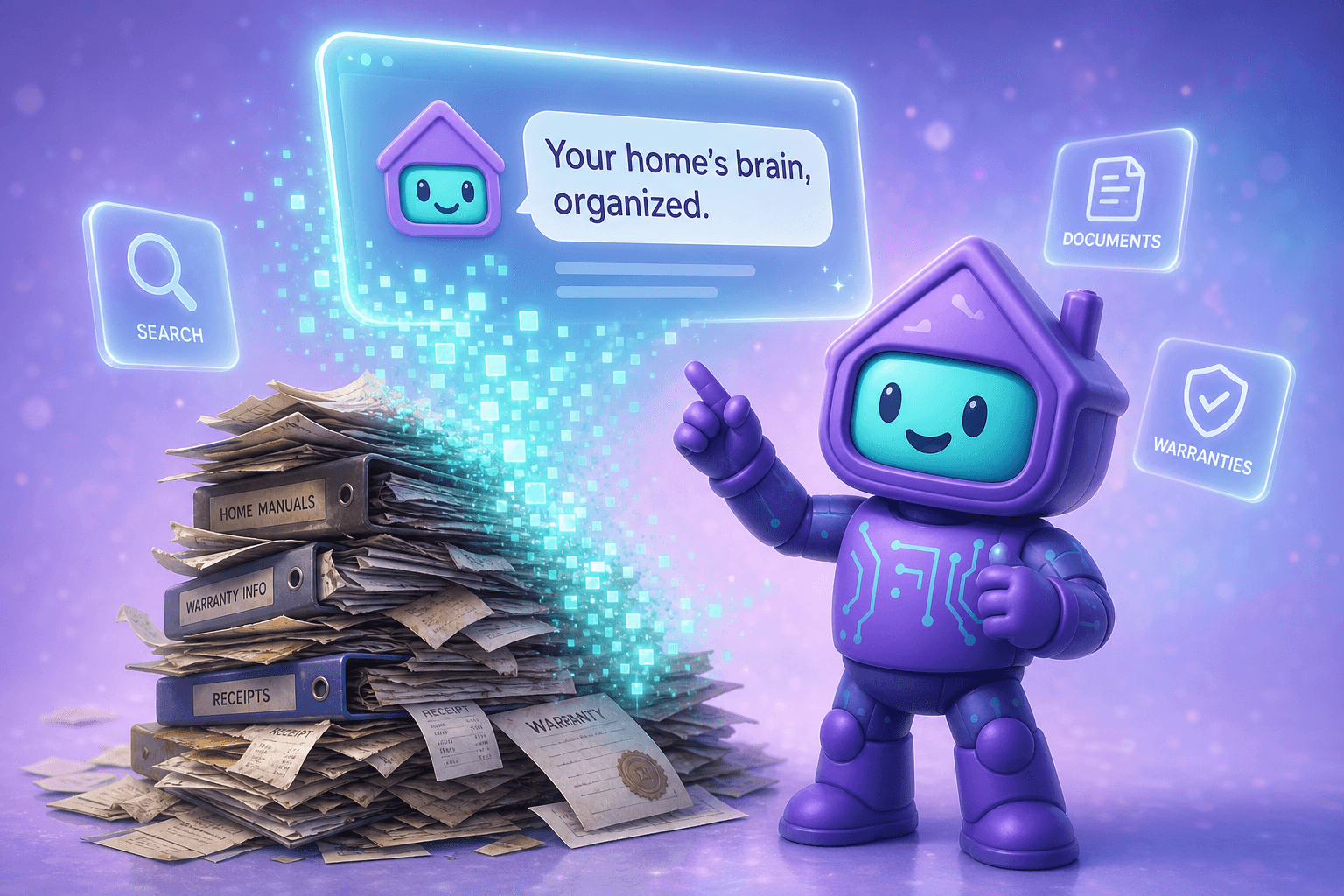
The home organization solutions recommended for decades are really filing systems in disguise.
The "home binder" is a great place to put information once you've collected it, organized it, and found the time to print or photocopy it. It's a terrible place to find information urgently. It's an even worse place to find information you didn't know you'd need.
Same with a spreadsheet. A well-designed spreadsheet for tracking home systems is genuinely useful to the person who built it, because that person had to decide upfront which columns to include, make a deliberate choice to enter each row, and maintain it consistently over years, through moves and renovations and the general chaos of life. That's a very high bar.
The underlying problem is that these tools were designed to store information, not to help you understand your home. Filing is not the same thing as knowledge.
How Information Actually Lives in a Home
Here's the honest picture of how home information enters most people's lives.
The contractor who installed your water heater told you something while he was packing up his tools, and you were half-listening because your phone was ringing. The receipt for the new dishwasher is in an email from three years ago under a subject line you'd never be able to predict. The warranty card that came with the range might have been mailed in, or might be in a drawer, or might have already expired. The previous owner of your house left a sticky note on the electrical panel that said "guest room: top right" and you've been meaning to figure out what that means.
This is not an organizational failure. This is how information actually arrives when you own a home. It comes in fragments, from different sources, in different formats, at inconvenient moments. No binder or spreadsheet changes the fundamental nature of that. You'd have to be a different kind of person, living a different kind of life, to successfully capture and maintain a complete home knowledge base using those tools.
The tools have been setting homeowners up to feel behind for decades. That's a category problem, not a personal one.
What Changes When the Tool Fits the Problem
The first wave of home inventory apps mostly moved the filing cabinet to your phone. Instead of a binder, you had an app where you could type in your appliance info. That's a better place to store a list, but it still requires the same consistent behavior from the homeowner. You have to enter the data to have the data. Most people don't, and so most people's home inventory apps are either empty or months out of date.
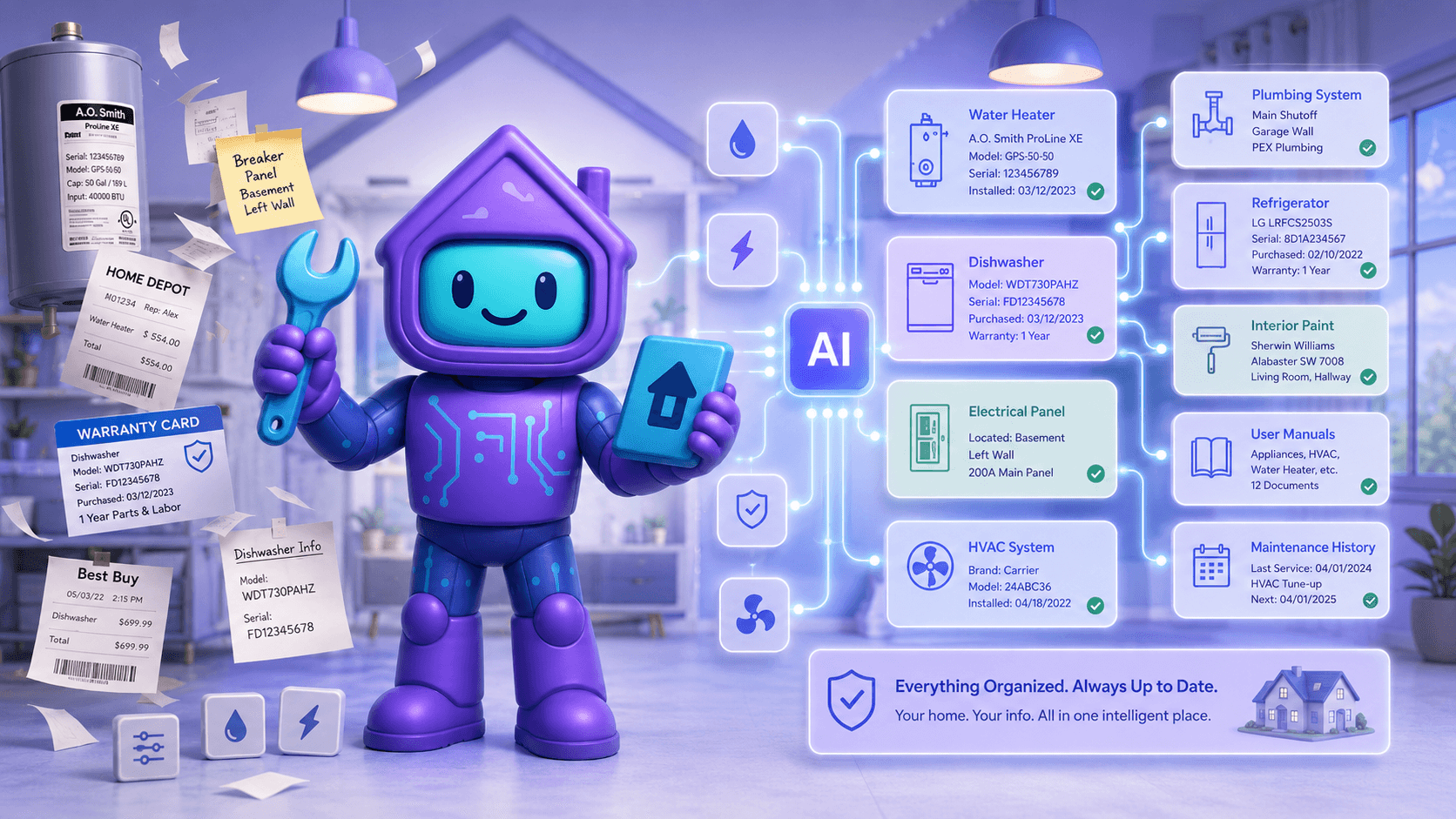
AI changes the input side of that equation. When you can take a photo of an appliance and have the system identify the make, model, and serial number automatically, you've removed the friction that caused most documentation efforts to fail. When you can upload a PDF of a repair receipt and have the system extract the relevant details and connect them to the right item, you've made it possible to do documentation in the moment, without needing to context-switch into "home management mode."
But the bigger shift is on the retrieval side. When your home's information is searchable and connected, you can ask questions the way humans actually ask questions. "What model is my water heater?" instead of "let me find the folder, remember what I named it, and scroll through the contents." The information was always there. The gap was between storage and recall.
Why This Matters More Than It Looks
I've talked to a lot of homeowners while building Dib, and the feeling that comes up most often isn't stress or panic. It's low-level, persistent guilt. The feeling that they should be more on top of things. That a responsible homeowner would know these details. That there's some version of themselves who actually has the binder organized and the spreadsheet up to date.
That feeling is misplaced. The tools they were given weren't designed for the actual shape of the problem. If a tool requires consistent behavior from every user to deliver value, the tool is fragile. Most people aren't going to change their behavior for a filing system. The filing system needs to change.
The goal isn't to turn homeowners into meticulous record-keepers. The goal is to build something that works even when you're not.
Where This Is Heading
We're early in figuring out what AI-native home management actually looks like. The category is young and the tools are still being shaped.
But the shift that matters most isn't any particular feature. It's the underlying assumption. The old assumption was: if homeowners do their part, consistently, the system works. The new assumption is: the system should work even when life gets in the way, which is most of the time.
If you've spent years feeling behind on knowing your own home, you're in good company. You weren't given great tools. That's starting to change.
Dib is an AI-powered home management platform. You can try it at dib.io.